
Let’s skip the buzzwords. Bespoke software development isn’t just “custom code with a higher price tag.” It’s software built specifically around how your business actually works your processes, your data, your constraints. No forced workflows. No unused features. No compromises just because a tool was built for the average company.
In this guide, I’ll explain what bespoke software development really means in 2026, why companies are still investing heavily in it despite the rise of SaaS, and when it makes more sense than off-the-shelf software. We’ll cover real-world costs, measurable benefits, common risks, and how to choose a development partner without getting burned.
If you want straight answers, practical insights, and zero fluff, you’re in the right place. Let’s break it down.
What Is Bespoke Software Development?
Bespoke software development is the process of building software exclusively for one business. Every feature, workflow, and integration is designed around specific operational needs, not a generic user base. Unlike off-the-shelf tools, bespoke software fits how your company already works instead of forcing you to adapt.
In 2026, demand for bespoke development remains strong because businesses need flexibility. As operations grow more complex, generic SaaS tools start to show their limits. This is especially true in regulated and process-heavy industries like healthcare, finance, logistics, and manufacturing, where “almost right” software quickly becomes a liability.
At its core, bespoke software exists to remove friction. If you’ve ever relied on spreadsheets, plugins, or manual workarounds to make a tool behave, bespoke development is the alternative software that works the way your business actually does.
Bespoke vs. Off-the-Shelf Software: Making the Right Choice
Choosing between bespoke and off-the-shelf software directly impacts cost, flexibility, and long-term growth. This quick comparison highlights where each option wins and where it falls short.
| Factor | Bespoke Software | Off-the-Shelf Software |
|---|---|---|
| Customization | Fully tailored to your workflows | Limited to preset options |
| Time to Launch | 4–8 months (avg.) | Days or weeks |
| Upfront Cost | Higher initial investment | Lower initial cost |
| Long-Term Cost | Lower over time | Higher due to recurring fees |
| Scalability | Built to grow with your business | Limited by the vendor roadmap |
| Integrations | Seamless, including legacy systems | Restricted |
| Control & Ownership | Full control over code and data | Vendor controlled |
| Best For | Complex needs, long-term strategy | Standard needs, quick rollout |
Choose off-the-shelf for speed and simplicity. Choose bespoke for control, scalability, and long-term strategic advantage.
Why Choose Bespoke Software in 2026?
By 2026, most businesses don’t fail because they lack tools; they fail because their tools don’t fit. Regulations shift, customer expectations rise, and systems become more interconnected every year. Bespoke software aligns technology with your actual workflows, allowing you to build exactly what your business needs instead of forcing teams to adapt to generic solutions.
That alignment creates a measurable competitive edge. Custom software lets you automate processes others still manage manually, integrate systems that don’t normally talk to each other, and deliver smoother customer experiences. In crowded markets, these operational advantages are difficult to replicate and often become the difference between leading and lagging.
While bespoke software requires a higher upfront investment, it often delivers better long-term value. You avoid recurring license fees for unused features, reduce dependence on third-party tools, and eliminate fragile workarounds. Just as importantly, bespoke systems are built with your security and compliance requirements in mind, giving you full control over data, access, and risk as regulations continue to tighten.
Key Steps in Bespoke Software Development
Bespoke software works best when it follows a clear, proven process. In 2026, these steps help reduce risk, align teams, and turn business goals into software that actually delivers:
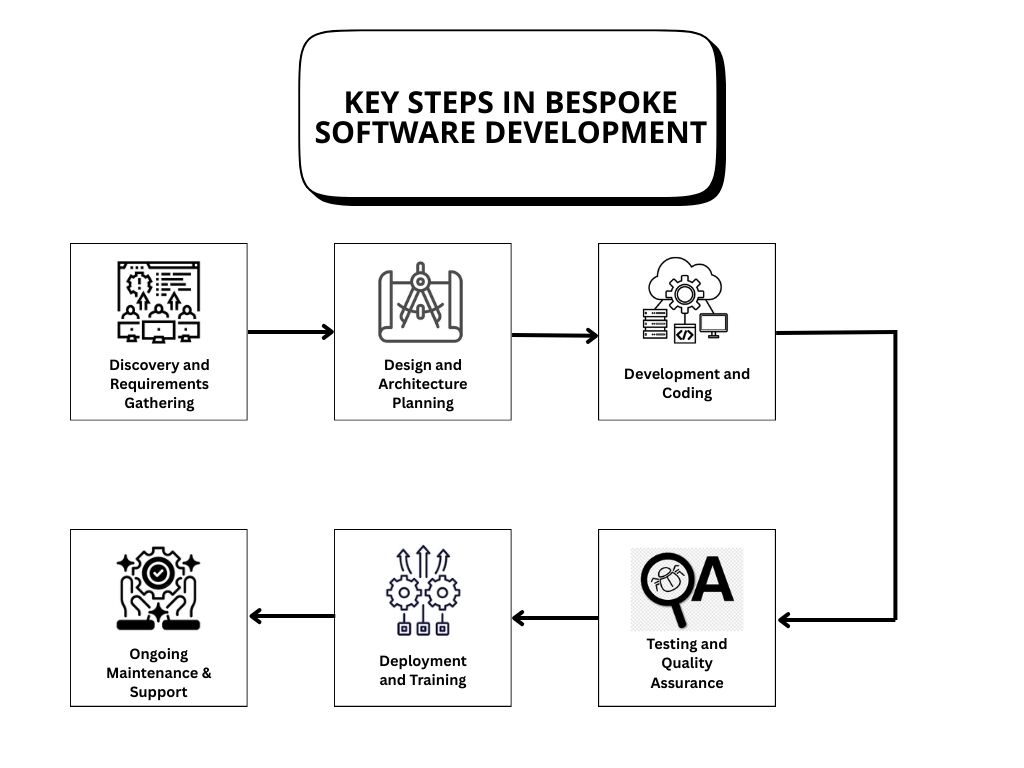
Step 1: Discovery and Requirements Gathering
This is where clarity is created or lost. The development team works closely with stakeholders to understand business goals, existing workflows, constraints, and pain points. The output isn’t just a feature list, but a shared understanding of what the software must achieve, who it’s for, and how success will be measured.
Step 2: Design and Architecture Planning
Once requirements are finalized, the team creates a clear roadmap by prioritizing features, setting timelines and budgets, and identifying risks, often using wireframes or prototypes to validate the experience before development begins. After approval, designers build the interface while architects define the technical foundation, choosing the tech stack, data structure, integrations, and infrastructure to ensure strong performance, scalability, and security.
Step 3: Development and Coding
This is where ideas turn into working software. Developers build features, set up databases, and integrate external services, usually following agile practices. Work is delivered in short sprints with regular demos, so progress stays visible, and feedback can be applied early before small issues turn into expensive fixes.
Step 4: Testing and Quality Assurance
Before launch, the software is pushed hard. QA teams test functionality, performance, security, and usability using both automated and manual methods. In 2026, this phase is about more than bug-hunting; it’s about ensuring the product is stable, secure, and ready for real-world usage from day one.
Step 5: Deployment and Training
Once testing is complete, the software is deployed to production, whether on cloud infrastructure or internal systems. The development team supports the rollout and helps train users through documentation, demos, and onboarding sessions. A smooth launch ensures teams adopt the software quickly and confidently.
Step 6: Ongoing Support and Maintenance
Bespoke software doesn’t stop evolving after launch. Ongoing support covers bug fixes, performance improvements, security updates, and new features as business needs change. In 2026, long-term success depends on treating software as a living system, one that adapts alongside your organization.
Who Needs Bespoke Software?
Bespoke software isn’t a default choice; it’s a strategic one. It makes the most sense for businesses whose operations don’t fit neatly into standard tools. If your workflows are unique, highly specialized, or central to how you compete, off-the-shelf software will eventually hold you back.
This is especially true for industries with strict compliance and regulatory requirements, such as finance, healthcare, and legal services, where generic solutions often introduce risk. It’s also a strong fit for startups building differentiated products and growing companies that have outgrown patchwork tools and spreadsheets.
If your team spends more time working around software than working with it, that’s usually the clearest signal that bespoke development is worth serious consideration.
Bespoke Software Development Costs in 2026
Bespoke software pricing in 2026 still spans a wide range, because no two projects or businesses are the same. What you’re really paying for is complexity, scale, and long-term flexibility, not just lines of code.
- Simple internal tools: $50,000–$100,000 for basic workflows and limited users
- Mid-sized systems: $150,000–$450,000 for customer portals, SaaS platforms, or mobile apps
- Enterprise platforms: $750,000+ for large-scale, multi-system, or compliance-heavy builds
- Key cost drivers: scope, integrations, tech stack (AI, cloud, mobile), and team location
- Ongoing costs: 15–25% annually for maintenance, updates, and security
The sticker price isn’t the full cost. Off-the-shelf software brings ongoing fees; bespoke costs more upfront, but you own the code and save long term.
How to Choose a Bespoke Software Development Partner
Choosing the right development partner matters as much as the software itself. Successful bespoke projects depend on experience, transparency, and long-term collaboration, not just technical skill in 2026:
Relevant Experience
Look for teams that have built software in your industry or handled similar levels of complexity. Relevant experience reduces onboarding time and helps teams anticipate challenges before they become problems. Ask for recent case studies, live products, and client references to validate that their expertise goes beyond marketing claims.
Clear Communication
Bespoke development is a collaborative process that spans months, not weeks. A strong partner communicates clearly, explains trade-offs in plain language, and responds consistently. In 2026, the ability to translate technical decisions into business impact is just as important as writing clean code.
Transparent Pricing
A reliable partner provides detailed, upfront pricing that covers discovery, design, development, testing, deployment, and support. Vague estimates often lead to scope disputes later. Clear cost breakdowns help you plan realistically and avoid unpleasant surprises as the project progresses.
Agile Approach
Modern bespoke teams work in short, iterative cycles. An agile approach includes regular demos, progress reviews, and the flexibility to adjust priorities as requirements evolve. This reduces risk, improves visibility, and ensures the final product reflects real user needs, not outdated assumptions.
Post-Launch Support
Software doesn’t stop evolving at launch. Ask how the team handles maintenance, security updates, performance tuning, and future enhancements. Strong post-launch support ensures your software stays reliable, secure, and aligned with your business as it grows.
Benefits of Bespoke Software Development
Bespoke software isn’t about customization for its own sake. In 2026, it’s about removing friction, improving efficiency, and giving businesses full control over the systems they rely on every day.
- Built to fit: Software designed around your exact workflows, with no workarounds or unused features
- Higher efficiency: Automation reduces manual tasks, errors, and operational overhead
- Scales with growth: Add users, features, or integrations without vendor-imposed limits
- Full ownership: You control the code, data, and roadmap, with no lock-in
- Stronger security: Security and compliance tailored to your industry and risk profile
- Better experiences: Interfaces optimized for both teams and customers, not generic users
Risks and Challenges of Bespoke Software Development
Bespoke software delivers control and flexibility, but it’s not risk-free. In 2026, the biggest challenges aren’t technical; they’re about cost, time, and discipline during execution.
- Higher upfront investment: Custom builds cost more than off-the-shelf tools, especially for complex systems
- Longer timelines: Planning, development, and testing take months, not weeks
- Scope creep: Uncontrolled feature additions can inflate budgets and delay delivery
- Vendor dependency: Weak partners or poor documentation can create long-term risk
- Ongoing maintenance: Updates, security patches, and improvements are continuous responsibilities
Real-World Examples of Bespoke Software Development
Bespoke software delivers the greatest impact when standard tools fall short. In 2026, businesses use custom-built systems to solve complex problems, streamline operations, and drive measurable results across industries.
Healthcare Scheduling Platform
A mid-sized healthcare clinic needed to coordinate patient appointments, staff availability, and medical records within a single system. Off-the-shelf tools couldn’t support their workflow complexity or compliance needs. A bespoke scheduling platform streamlined operations, reduced administrative work by 40%, and improved patient satisfaction by minimizing delays and booking errors.
Logistics Automation Tool
A growing logistics company relied on manual tracking and fragmented systems, leading to frequent delivery errors and poor visibility for clients. Custom-built software automated route planning, shipment tracking, and status updates. The result was fewer delays, better fuel efficiency, and real-time tracking that significantly improved customer trust and operational control.
Finance Compliance Dashboard
When new compliance regulations took effect, a financial services firm found existing reporting tools inadequate. A bespoke compliance dashboard integrated data from multiple internal systems and generated audit-ready reports on demand. This reduced manual reporting work, improved accuracy, and saved compliance teams several hours each week.
eCommerce Personalization Engine
An online retailer wanted to move beyond generic recommendations and increase conversions. A bespoke personalization engine analyzed customer behavior in real time and dynamically adjusted product suggestions. Within three months, the retailer saw an 18% increase in conversion rates and higher average order values without increasing ad spend.
What to Expect in a Bespoke Software Project Timeline
Bespoke software timelines vary, but in 2026, the structure is fairly predictable. Most projects move through a clear sequence of phases, each designed to reduce risk and prevent costly rework later.
Discovery and planning typically take 2–4 weeks, followed by 3–6 weeks of design and prototyping to validate user flows and technical assumptions. Core development usually runs 2–6 months, depending on complexity, integrations, and scale. Testing and quality assurance add another 2–4 weeks, with 1–2 weeks for deployment, onboarding, and training.
In practice, most bespoke projects land in the 4–8 month range. Build in time for feedback, iteration, and last-mile refinements because rushing custom software almost always costs more in the long run.
Emerging Tech in Bespoke Software Development in 2026
In 2026, bespoke software is shaped as much by architecture choices as by features. The most effective systems are built to be intelligent, scalable, and ready to evolve as new technologies mature.
- AI and machine learning: Custom models for prediction, automation, and decision support trained on your data, not generic datasets
- Cloud-native architecture: Scalable, resilient systems using managed cloud services to reduce ops overhead
- IoT integrations: Real-time data pipelines from sensors, devices, and trackers for operational insight
- API-first development: Modular systems that integrate easily with internal tools, partners, and future platforms
How to Get Started with Bespoke Software Development
Starting a bespoke software project doesn’t require a massive leap, just a clear plan. In 2026, the most successful teams begin with alignment, not code, and move forward step by step to reduce risk and avoid expensive course corrections.
Define Your Goals
Begin by clarifying the business problem you’re solving and why software is the right solution. Define what success looks like in measurable terms efficiency gains, revenue impact, or risk reduction. Clear goals keep the project focused and make it easier to evaluate progress throughout development.
List Your Must-Have Features
Resist the urge to design everything at once. Identify the core features required for a successful launch and separate them from nice-to-haves. This approach helps control scope, shorten timelines, and ensures early versions of the software deliver real value to users.
Set a Budget and Timeline
Establish realistic financial and time constraints based on business priorities. A clear budget and timeline help development partners propose practical solutions instead of over-engineered ones. In 2026, flexibility matters, but boundaries are what keep projects on track.
Research Development Partners
Shortlist partners with experience in your industry or similar projects. Review case studies, live products, and client feedback. A strong track record reduces onboarding time and helps teams anticipate challenges before they slow down delivery.
Request and Compare Proposals
Ask shortlisted teams to outline their approach, timelines, deliverables, and pricing. Look beyond the total cost, pay attention to assumptions, communication style, and risk management. The best proposal is the one that shows clear thinking, not just the lowest price.
Choose Your Partner and Formalize the Agreement
Once you select a partner, lock down scope, milestones, ownership rights, and support terms in writing. Clear contracts and shared expectations set the foundation for a smooth collaboration and long-term success.
Is Bespoke Software Trendy or Is It Necessary?
Bespoke software isn’t a passing trend; it’s a practical response to growing complexity. As businesses scale, standard tools often become constraints rather than enablers. When workflows are unique, compliance is strict, or differentiation matters, custom-built software stops being optional and starts becoming essential.
In 2026, the most resilient companies don’t just adopt technology; they design it around their goals. Bespoke software gives them control, flexibility, and a foundation that can evolve with the business. The key is approaching it strategically: define clear outcomes, choose experienced partners, and invest with a long-term mindset.
If you’re questioning whether bespoke software is right for you, that’s usually the first sign it’s worth exploring. Map your requirements, speak with trusted development teams, and evaluate the opportunity, not just the cost. The right decision today can shape how your business competes tomorrow.
