IoT software is no longer a niche. In 2026, it powers everything from consumer smart homes to mission-critical industrial systems. But successful IoT products aren’t built by “just connecting devices.” They’re built with secure architectures, scalable data pipelines, and software that delivers real business outcomes, not dashboards no one uses.
This guide breaks down exactly how IoT software development works today. You’ll learn the core architecture, technology stack choices that actually make sense in 2026, realistic cost ranges, and the mistakes that quietly kill IoT projects after launch. No theory. No vendor hype. Just practical guidance based on what works in production.
If you’re a CTO, product leader, or founder evaluating an IoT idea, this is your roadmap from first sensor to a system that scales. Let’s get into it.
What Is IoT Software Development?
IoT software development is about building systems that connect physical devices to the internet and make the data they produce genuinely useful. These devices (sensors, machines, wearables, appliances) collect data from the real world, transmit it through networks, and trigger insights or actions through software.
Unlike traditional applications, IoT software must operate under messy, unpredictable conditions: unstable connectivity, hardware failures, power constraints, and real-time data streams. That’s why IoT systems rely on a layered stack of embedded firmware on devices, communication protocols, cloud platforms for processing and storage, and user-facing apps or dashboards.
The end goal isn’t “connected devices.” It’s reliable automation, smarter decisions, and measurable business value. Good IoT software turns raw sensor data into outcomes users can trust at scale, and over time. In IoT software development, custom-built software development solutions are often essential because every connected ecosystem is different, and only tailored software can seamlessly integrate devices, data streams, and real-time intelligence into a reliable, scalable system.
Core Layers of IoT Software Development
In 2026, successful IoT systems are built in layers. Each layer solves a specific problem, and weaknesses at any level quickly surface at scale.
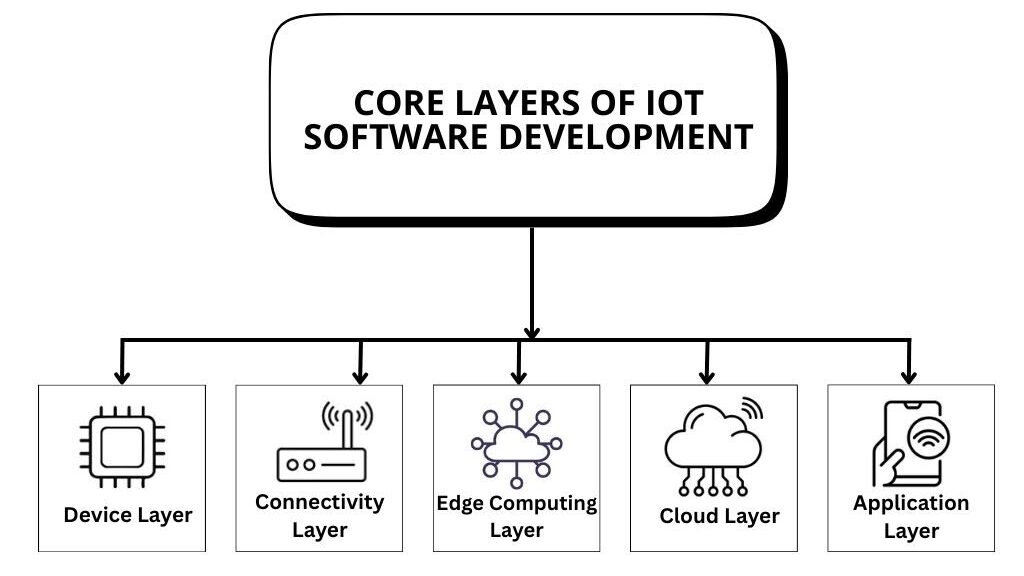
- Device layer: Sensors and actuators interact with the physical world through embedded firmware. Code must be lightweight, power-efficient, and reliable, commonly using C, C++, or Rust.
- Connectivity layer: Devices communicate using MQTT, CoAP, or HTTP based on latency and reliability needs. Strong encryption and device authentication are mandatory.
- Edge computing layer: Data is processed close to the source to reduce latency and cloud costs. Edge logic enables real-time decisions and offline operation.
- Cloud layer: Centralized platforms handle data storage, analytics, device management, and automation at scale.
- Application layer: Dashboards and apps turn data into actionable insights. Usability here determines adoption and long-term value.
Key Steps in IoT Software Development (2026)
IoT software succeeds or fails based on process, not ideas. Following a structured approach helps teams reduce risk, control costs, and scale reliably in 2026:
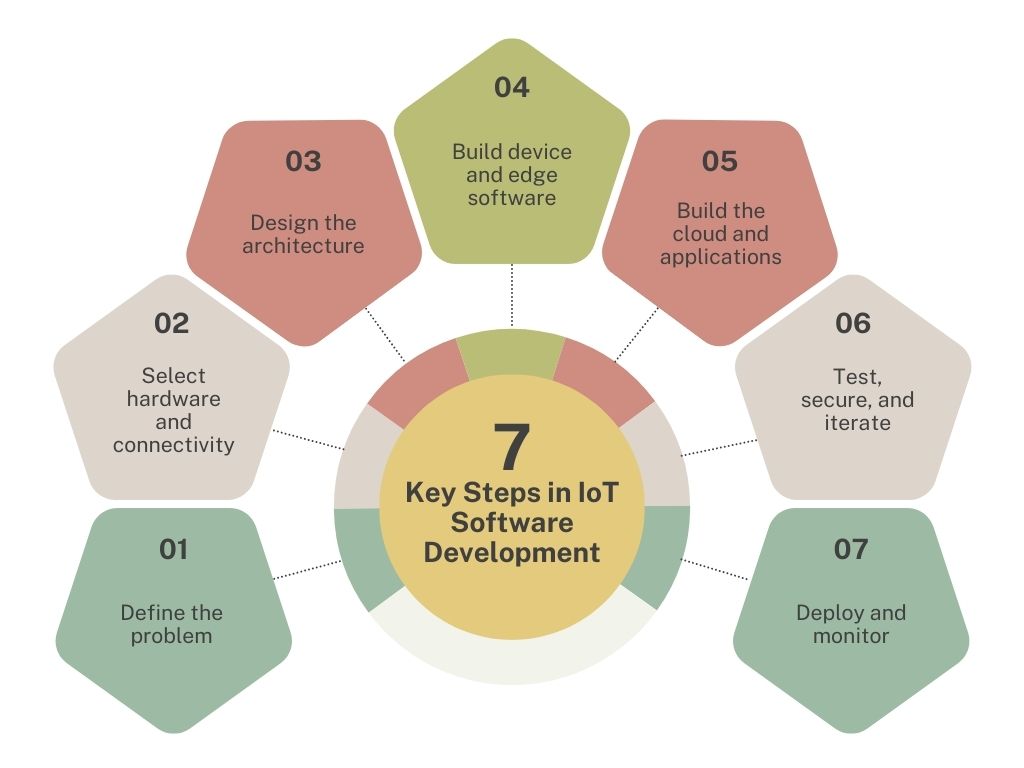
Step 1: Define the problem
Every successful IoT system starts with a clear business problem, not a list of devices. You need to understand who the users are, what decisions the system must enable, and how success will be measured. Teams that skip this step end up building technically impressive systems that solve nothing and are expensive to fix later.
Step 2: Select hardware and connectivity
Hardware choices lock in constraints early. Sensors, devices, and networks must survive real environments, meet power limits, and deliver reliable data. Connectivity decisions, Wi-Fi, cellular, LPWAN, or hybrid, directly shape cost structure, performance, and long-term scalability. Changing them later is rarely cheap.
Step 3: Design the architecture
Architecture determines whether your IoT system scales or collapses under growth. You must define how data flows across device, edge, cloud, and application layers, where processing happens, and how failures are handled. Good architecture balances flexibility today with predictable operating costs tomorrow.
Step 4: Build device and edge software
This is where theory meets reality. Firmware and edge logic must handle power loss, network instability, and imperfect hardware. Reliability and fault tolerance matter more than elegance. Real-world testing is essential because most IoT failures happen outside controlled environments.
Step 5: Build the cloud and applications
The cloud is where IoT data becomes useful. This step focuses on ingestion, storage, analytics, and interfaces that surface insights quickly. Planning for device provisioning, OTA updates, authentication, and access control early prevents operational chaos as the system grows.
Step 6: Test, secure, and iterate
This is where many IoT projects either mature or quietly fail. Testing must go beyond functional checks and include network failures, corrupted data, device drop-offs, and security attacks. Continuous security reviews, telemetry analysis, and user feedback help teams identify weaknesses early. Iteration isn’t a phase; it’s a permanent operating mode for IoT systems.
Step 7: Deploy and monitor
Deployment marks the transition from development to operations. Rolling out in controlled phases reduces risk and reveals issues that don’t appear in testing. Continuous monitoring of device health, data quality, performance, and cloud costs is critical. Without proactive monitoring and alerting, small anomalies can quickly turn into large-scale outages.
Common Challenges in IoT Software Development
IoT projects don’t fail because the idea is bad. They fail because teams underestimate the operational complexity. These are the issues that still catch teams off guard in 2026:
- Security risks: Every new device expands the attack surface. Weak credentials and outdated firmware remain top threats. Encryption, strong authentication, and secure OTA updates must be built in from day one.
- Scalability issues: A working pilot doesn’t guarantee production readiness. Scaling means handling traffic spikes, mass provisioning, and fleet-wide updates without downtime. Early architecture choices decide how painful growth becomes.
- Data overload: IoT systems generate far more data than they need. Without edge filtering, costs rise fast, and insights get buried. Focus on signal, not storage.
- Integration complexity: IoT rarely stands alone. Connecting to ERPs, CRMs, and third-party systems adds friction. Standard APIs and data models reduce long-term pain.
- Device management: Monitoring health, pushing updates, and remote troubleshooting get harder at scale. Weak tooling turns operations into the bottleneck.
Choosing an Effective IoT Software Development Tools in 2026
Your tooling decisions will shape how fast you ship and how painful it is to scale. In 2026, flexibility, security, and long-term operability matter more than vendor features.
Programming Languages
C and C++ remain the standard for embedded firmware due to performance and hardware control. Rust is gaining traction for its memory safety and reliability. For cloud and edge development, Python, Node.js, and Go offer fast iteration and strong ecosystems.
IoT Platforms
IoT platforms handle device onboarding, messaging, analytics, and monitoring at scale. AWS IoT Core, Azure IoT, and Google Cloud are widely used in production. Open-source platforms like ThingsBoard are useful for highly customized or cost-sensitive deployments.
Protocols and Standards
MQTT and CoAP are still the preferred protocols for lightweight communication. HTTPS and REST dominate cloud integrations. Support for TLS 1.3, secure boot, and device authentication is essential.
Testing and Simulation Tools
IoT testing requires simulating unreliable networks, hardware faults, and power issues. Simulation tools help expose failures early. This reduces costly surprises after deployment.
Device Management Solutions
Managing devices at scale requires OTA updates, real-time monitoring, and automated provisioning. The right tooling prevents operational bottlenecks. It also keeps long-term maintenance manageable as fleets grow.
IoT Software Development Cost Breakdown (2026)
Let’s get realistic about costs. IoT software pricing isn’t about a single number; it’s about scope, scale, and how production-ready you want to be.
- Prototype: $30,000–$70,000 (limited hardware, basic firmware, a lightweight cloud setup, and a simple app or dashboard)
- Full Product: $150,000–$700,000+ (hardened firmware, scalable cloud infrastructure, analytics, device management, security compliance, and support for large device fleets)
Factors that drive costs:
- Hardware complexity: Custom boards, specialized sensors, and certifications push costs up fast. Off-the-shelf hardware is cheaper upfront but can limit flexibility and future scale.
- Software scope: Every extra feature adds development, testing, and long-term maintenance. A focused MVP keeps costs predictable. Expand only when real usage proves demand.
- Security features: Security raises initial costs but prevents far bigger losses later. Encryption, secure boot, OTA patching, and audits are now baseline requirements.
- Cloud and data costs: Storage and processing scale with devices and data volume. Weak forecasting leads to surprise bills. Edge processing helps control spend.
- Maintenance and support: IoT is never “done.” Ongoing updates, monitoring, and support typically cost 15–20% of the original build each year.
Best Practices for IoT Software Development in 2026
Successful IoT products aren’t built by accident. Teams that ship reliably follow proven practices that reduce risk, control costs, and scale smoothly in production.
Start Small, Scale Fast
Begin with a narrowly defined pilot focused on a single, high-value use case. Use real-world data to validate assumptions around performance, reliability, and cost. Scale only after the system proves stable and valuable in production conditions.
Prioritize Security from Day One
Security must be designed into every layer, not added later. Implement secure boot, encrypted communication, and strong device authentication from the start. Regular patching and continuous vulnerability monitoring are now baseline requirements.
Design for Interoperability
IoT systems rarely operate in isolation. Use open standards, well-documented APIs, and flexible data models to simplify integrations. This approach future-proofs your platform as tools, vendors, and partners evolve.
Automate Testing and Monitoring
Manual testing breaks at scale. Automate firmware tests, cloud validations, and real-world simulations to catch failures early. Continuous monitoring and alerting help prevent small issues from turning into outages.
Optimize for Power and Bandwidth
Many devices operate on limited power and low-bandwidth networks. Reduce data transmission, use edge processing, and design efficient communication patterns. These choices directly impact device lifespan and operating costs.
Plan for Remote Device Management
Remote diagnostics and OTA updates are essential once fleets grow. Build update mechanisms early and make rollback safe. Real-time visibility into device health keeps operations manageable.
Focus on User Experience
Even technically sound systems fail without adoption. Design dashboards and apps that surface clear, actionable insights. Use real user behavior to guide ongoing improvements after launch.
Real-World IoT Software Development Examples
In 2026, IoT software delivers the most value when it solves real, everyday problems at scale. Across industries, teams combine edge computing, cloud platforms, and intuitive applications to turn raw device data into reliable, real-world outcomes.
- Smart agriculture: Sensors track soil, weather, and crop conditions in real time. Edge processing triggers irrigation alerts, while cloud dashboards optimize water usage and yields.
- Industrial automation: Factories monitor machine health using IoT sensors and predictive analytics. Edge logic enables instant shutdowns, and mobile apps keep maintenance teams informed.
- Healthcare monitoring: Wearables stream patient vitals to secure cloud platforms. Clinicians use live dashboards for remote care, with encryption and strict access controls.
- Smart cities: Connected sensors manage traffic, air quality, and public safety systems. Edge processing reduces latency, while centralized dashboards support faster decisions.
- Consumer smart devices: Smart home apps control devices seamlessly. OTA updates deliver new features and fixes without disrupting users.
How to Choose an IoT Software Development Partner
Most teams don’t build IoT platforms entirely in-house, and that’s fine. The right development partner can accelerate delivery, reduce risk, and prevent costly mistakes in 2026:
- Relevant experience: Look for teams with IoT systems running in production, not just demos. Industry familiarity helps, but proven expertise across embedded firmware and cloud platforms matters more.
- Security know-how: Security should be foundational, not optional. Ask about secure coding, OTA update strategies, and compliance experience. Teams that can explain past trade-offs usually build safer systems.
- Flexible engagement: Real-world IoT requirements change fast. Your partner must adapt the scope, reprioritize work, and support the product post-launch. Clear communication is essential.
- Proven process: Strong teams follow a repeatable process from discovery to testing and delivery. Documentation, QA, and monitoring should be standard, not shortcuts.
Building IoT Software That Works in 2026
IoT software development is still hard, but in 2026, the rules are clearer than ever. The teams that succeed start with a real, measurable problem, design for the physical world, and treat security and reliability as non-negotiable foundations. Tools matter, but architecture, testing, and operational discipline matter more.
The winning approach is simple: ship small, learn fast, and scale with intent. Test in real conditions, listen closely to users, and assume requirements will change after launch. That’s how IoT products stay reliable, secure, and relevant long after the first devices go live.
If you’re planning an IoT initiative, now is the right time to do it properly. Ask better questions, avoid shortcuts, and build for the long term. That’s how connected ideas turn into systems that actually work.
