
Outsourcing software development isn’t a trend anymore; it’s a strategy. And in 2026, the question isn’t whether to outsource, but how to do it without wasting time or money.
Global demand for skilled developers is still outpacing supply. Hiring locally is expensive, slow, and often unrealistic. Outsourcing opens the door to faster delivery, broader expertise, and predictable costs, but only if you get the model right. Get it wrong, and you’ll pay for it in delays, rework, and missed goals.
This guide cuts through the noise. You’ll learn when outsourcing actually makes sense, what it really costs in 2026, the most common failure points, and how experienced teams avoid them. No buzzwords. No fluff. Just practical insights to help you decide and execute with confidence.
What Is Outsourcing Software Development?
Outsourcing software development is when you hire an external team to design, build, maintain, or scale software instead of doing everything in-house. That can mean anything from a simple mobile app to a complex, enterprise-grade platform.
Companies outsource for three main reasons: speed, cost efficiency, and access to skills they don’t have internally. Your development partner might be local, nearshore, or offshore, but they operate outside your full-time payroll and internal hiring constraints. In outsourcing, custom software development ensures your product is built around your goals, timelines, and quality standards, not a vendor’s template.
In 2026, outsourcing isn’t a “big company” tactic. Startups, SMBs, and enterprises all use it to ship faster, stay flexible, and compete without bloating their teams.
Why Companies Outsource Software Development in 2026
In 2026, companies outsource software development to remove hiring bottlenecks and move faster. Access to global talent makes it easier to find experienced engineers, especially for niche or fast-evolving tech stacks that are hard to source locally.
Cost efficiency plays a role, but it’s about value, not cheap labor. Outsourcing lets teams control budgets, avoid long-term salary commitments, and get solid expertise without overbuilding internal teams.
Just as important, outsourcing improves speed and flexibility. Projects can start immediately, scale up or down as needs change, and adopt modern tools without constant retraining while internal teams stay focused on core business priorities.
Types of Outsourcing Models
Not all outsourcing models deliver the same results. In 2026, the right choice depends on how much control, speed, and risk your project can tolerate. Geography matters, but execution, communication, and alignment matter more.
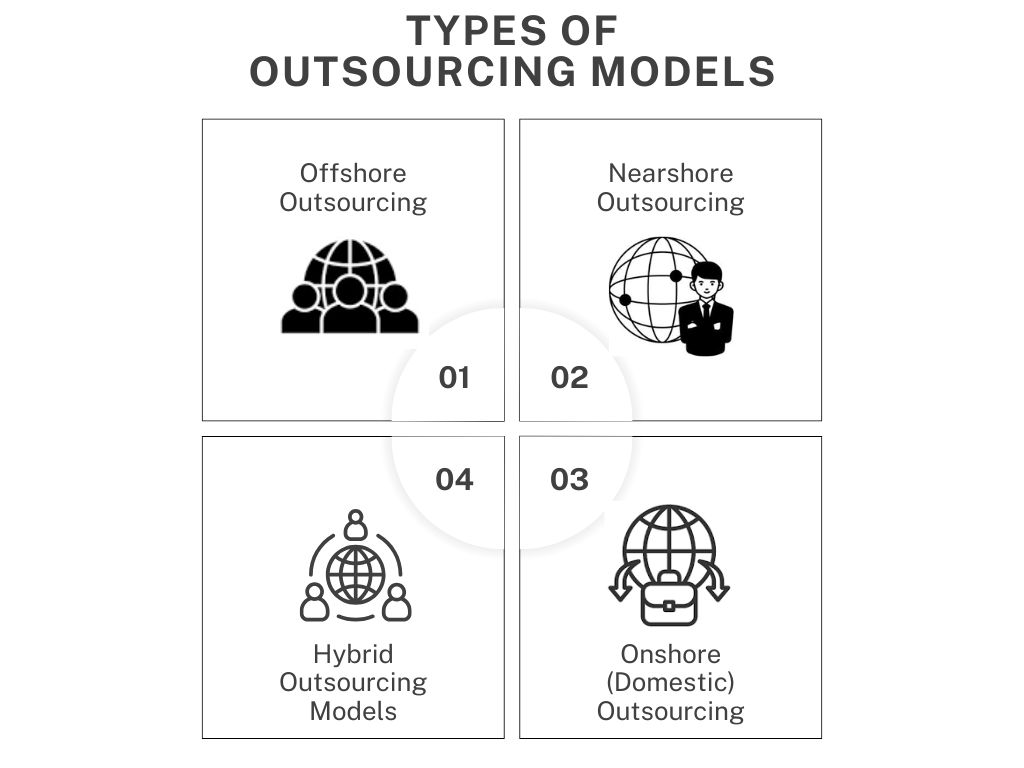
Offshore Outsourcing
Offshore outsourcing means working with a development team in a distant country, such as India, Ukraine, or the Philippines. It’s typically the most cost-efficient option and works well for clearly defined projects. The trade-offs include time zone gaps, communication friction, and heavier reliance on strong documentation and process discipline.
Nearshore Outsourcing
Nearshore outsourcing involves teams in nearby or neighboring countries. For U.S. companies, this often means Latin America or Mexico. The biggest advantage is time zone overlap, which enables real-time collaboration. Costs are higher than offshore but lower than domestic, making nearshore a popular middle ground in 2026.
Onshore (Domestic) Outsourcing
Onshore outsourcing keeps development within your home country. It’s the most expensive model but offers easier communication, shared business culture, and simpler legal compliance. Companies often choose onshore partners for regulated industries, sensitive data, or projects where speed of feedback and tight alignment matter more than cost.
Hybrid Outsourcing Models
Hybrid models combine in-house teams with offshore or nearshore partners. Core architecture or product strategy stays internal, while execution-heavy work is outsourced. This approach offers flexibility and cost control but demands mature project management. In 2026, hybrid models are common among scaling companies that want speed without losing control.
Knowing When Outsourcing Works (and When It Doesn’t)
Outsourcing isn’t a one-size-fits-all solution. In 2026, it’s about picking the right fit for your project, balancing speed, cost, and control. Knowing when to outsource and when to keep work in-house can save time, money, and headaches.
- Best Use Cases: MVPs, one-off projects, maintenance, or quick access to specialized skills. Ideal for non-core functions like QA, DevOps, or legacy updates.
- When to Avoid: Mission-critical systems, sensitive data projects, or work requiring tight, real-time collaboration. In-house teams excel where deep product knowledge and rapid feedback are key.
- How to Decide: Consider budget, timeline, and control needs. Outsource for flexibility; keep it in-house when integration and speed are non-negotiable.
How to Choose the Right Outsourcing Partner
In 2026, the right outsourcing partner reduces risk and acts as an extension of your team, aligned on goals, process, and delivery from day one.
Define Your Project Clearly
Start with a detailed project brief that spells out goals, scope, tech stack, timelines, and budget. Ambiguity is the fastest way to derail outsourcing. The clearer your expectations, the easier it is to evaluate partners and the harder it is for misunderstandings to creep in once development starts.
Check Technical Expertise
Don’t rely on marketing pages. Look for hands-on experience in the exact technologies you need. Review recent case studies, ask for client references, and have them explain real implementation decisions. In 2026, strong partners can clearly articulate why they chose a solution, not just what they built.
Assess Communication Skills
Technical skills mean little without clear communication. Evaluate response times, clarity, and willingness to ask questions early. Delayed replies or vague answers are warning signs. For agile or fast-moving projects, consistent communication matters as much as clean code.
Evaluate Cultural Fit
Work styles need to align. If your team runs sprint-based development, your partner should too. Ask about their planning process, feedback loops, and escalation paths. A cultural mismatch doesn’t show up on day one, but it quietly slows everything down.
Understand Their Security Practices
Security is non-negotiable in 2026. Ask how they handle data access, code repositories, and compliance requirements. Look for documented security processes, relevant certifications, and a clear incident-response plan. If answers feel vague or defensive, walk away.
Review Contracts and SLAs
Everything should be documented: scope, timelines, ownership, and payment terms. A strong contract protects both sides, while SLAs set clear expectations for quality, availability, and response times. If a partner avoids specifics here, that’s a risk you don’t need.
Outsourcing Software Development Costs in 2026
In 2026, outsourcing costs aren’t just about hourly rates; they’re about value, speed, and quality. Understanding regional pricing, contract types, and hidden expenses helps you budget smarter and avoid surprises.
- Hourly Rates by Region: North America ~$75–$250/hr | Western Europe ~$70–$150/hr | Eastern Europe ~$40–$80/hr | Latin America ~$35–$85/hr | India/SE Asia ~$25–$55/hr. Rates reflect skill, experience, and delivery speed.
- Fixed Price vs. Time & Materials: Fixed price suits well-defined projects; time & materials works for evolving scopes. Pick based on risk tolerance and flexibility.
- Hidden Costs: Don’t forget project management, onboarding, time zone coordination, and rework. Low rates can become expensive if quality or communication suffers.
Risks and Challenges of Outsourcing Software Development
Outsourcing software development in 2026 comes with real benefits but also risks. Knowing the common challenges upfront helps you avoid costly mistakes and keep projects on track.
- Communication Gaps: Time zones and language differences can slow progress. Schedule regular check-ins and document everything clearly.
- Quality Control: Not every partner delivers top-tier code. Set standards, enforce code reviews, and use test-driven development.
- Security & IP: Protect data with NDAs, secure repositories, and strict access control. Clarify IP ownership in contracts.
- Hidden Costs: Scope creep, rework, and management overhead can inflate budgets. Build buffers and stay hands-on.
- Loss of Control: Mitigate by defining milestones, tracking progress, and maintaining open communication.
- Vendor Lock-In: Keep code accessible, document thoroughly, and avoid proprietary tools to stay flexible.
Best Practices for Successful Outsourcing Software in 2026
Outsourcing succeeds when it’s a partnership, not a handoff. In 2026, winning teams set clear expectations, strong communication, and shared accountability from day one.
Start Small and Scale Up
Begin with a pilot project or a clearly defined module. This allows you to evaluate technical quality, communication style, and delivery speed with limited risk. If the collaboration works, scaling up becomes far smoother than committing to a large, high-stakes project upfront.
Use Clear Documentation
Detailed requirements, user stories, and acceptance criteria are essential for distributed teams. Clear documentation reduces assumptions, speeds up onboarding, and keeps everyone aligned as the project evolves. In 2026, strong documentation is one of the fastest ways to prevent scope creep and rework.
Hold Regular Meetings
Consistent communication keeps projects moving. Weekly standups, sprint reviews, and planning calls help surface issues early and maintain momentum. Video calls are especially valuable for building trust and context, which are hard to establish through messages and tickets alone.
Set Measurable Milestones
Break the project into phases with specific deliverables and success criteria. Milestones make progress visible, simplify payment schedules, and help identify risks before they escalate. Well-defined checkpoints keep both sides focused on outcomes, not just activity.
Invest in Onboarding
A structured onboarding process saves weeks of back-and-forth later. Share product context, business goals, workflows, and technical standards early. The better your outsourcing team understands your business, the faster they can make decisions and deliver meaningful results.
Use Project Management Tools
Centralized tools like Jira, Trello, or Asana provide visibility into tasks, bugs, and timelines. In 2026, transparency is non-negotiable, shared dashboards and real-time updates help teams stay accountable and prevent unpleasant surprises near delivery.
Managing Remote Teams the Right Way
Managing remote teams in 2026 is less about control and more about clarity and trust. The teams that perform best are aligned on expectations, empowered to act, and supported by fast, consistent communication.
- Overcommunicate: Share updates often, restate priorities, and clarify expectations. Silence creates confusion.
- Respect Time Zones: Schedule fair meeting times, rely on async tools, and account for local holidays.
- Build Relationships: Trust matters. Encourage informal check-ins, celebrate wins, and recognize good work.
- Encourage Ownership: Let teams make decisions and solve problems. Micromanagement slows everything down.
- Provide Fast Feedback: Quick responses prevent blockers, reduce rework, and keep momentum high.
Common Pitfalls to Avoid in Outsourcing Software Projects
Most outsourcing failures in 2026 aren’t caused by bad developers; they’re caused by avoidable decisions. Knowing these pitfalls early helps you protect your budget, timeline, and product quality.
- Choosing Price Alone: The cheapest option often hides costs in quality, delays, or communication issues.
- Unclear Requirements: Vague specs lead to rework and missed expectations. Document everything upfront.
- Weak Legal Coverage: Skipping contracts or NDAs puts your IP and data at risk.
- Poor Communication: Infrequent updates cause misalignment. Use regular check-ins and shared tools.
- No Handover Plan: Ensure clean code, documentation, and access from day one to avoid lock-in later.
Trends in Outsourcing Software Development for 2026
Outsourcing in 2026 is more mature, more strategic, and more results-driven than ever. Companies are prioritizing outcomes, security, and collaboration, not just cost savings.
- AI-Driven Delivery: AI tools now assist with planning, code reviews, testing, and risk detection, improving speed and predictability.
- Security First: Cybersecurity is non-negotiable. Clients expect audits, compliance, and secure-by-design development.
- Nearshore Growth: Nearshore teams in Latin America and Eastern Europe are rising due to time zone overlap and cultural alignment.
- Outcome-Based Contracts: Pricing is shifting from hours to deliverables, milestones, and measurable ROI.
- Soft Skills Matter: Clear communication, ownership, and adaptability now matter as much as technical expertise.
How to Get Started with Outsourcing Software Development
Outsourcing works best when it’s intentional. In 2026, successful teams treat outsourcing as a structured process, not a last-minute fix. A clear roadmap helps you reduce risk, set expectations early, and build momentum without overcommitting.
Define Your Project Scope, Goals, and Budget
Start by documenting what you want to build, why it matters, and how success will be measured. Define scope boundaries, technical requirements, timelines, and a realistic budget range. The clearer this foundation, the easier it is to evaluate partners and the harder it is for scope creep to derail the project later.
Research and Shortlist Potential Partners
Look beyond marketing claims. Focus on partners with proven experience in your industry or tech stack. Review case studies, client testimonials, and delivery models. In 2026, strong vendors are transparent about processes, pricing, and limitations, shortlisting those who clearly explain how they work.
Interview Teams and Check References
Treat this like hiring, not purchasing. Speak with the actual developers or project leads, not just sales reps. Ask about recent challenges, communication routines, and decision-making processes. Reference checks help confirm whether the team delivers consistently or only talks a good game.
Start with a Small Project or Pilot
Don’t commit everything upfront. Begin with a pilot project to test collaboration, code quality, and reliability. This reduces risk and reveals how the team handles feedback, deadlines, and change. In 2026, pilots are the fastest way to validate fit before scaling.
Set Up Clear Contracts and Communication Channels
Lock in expectations early. Contracts should clearly define scope, timelines, IP ownership, security requirements, and payment terms. Establish communication channels, reporting cadence, and escalation paths. Clarity here prevents misunderstandings and protects both sides as the project grows.
Track Progress, Give Feedback, and Adjust
Outsourcing isn’t “set and forget.” Track milestones, review deliverables regularly, and provide fast, specific feedback. Use dashboards and project tools to stay visible without micromanaging. The best results in 2026 come from active collaboration and continuous adjustment.
Is Software Outsourcing Worth It in the End?
In 2026, software outsourcing isn’t a gamble; it’s a calculated trade-off. You gain speed, flexibility, and access to global talent, but you give up some direct control. Whether it’s worth it depends less on the model you choose and more on how clearly you define success and manage execution from day one.
Outsourcing works best for teams that treat it as a partnership, not a transaction. Clear documentation, frequent communication, and shared accountability turn external developers into an extension of your product team. When that alignment clicks, outsourcing can outperform traditional in-house builds, especially for MVPs, scaling phases, or specialized work.
If you’re unsure, don’t overcommit. Start small, validate fast, and scale what works. Done right, outsourcing isn’t a shortcut or a compromise; it’s a modern way to build software efficiently in 2026 and beyond.
